
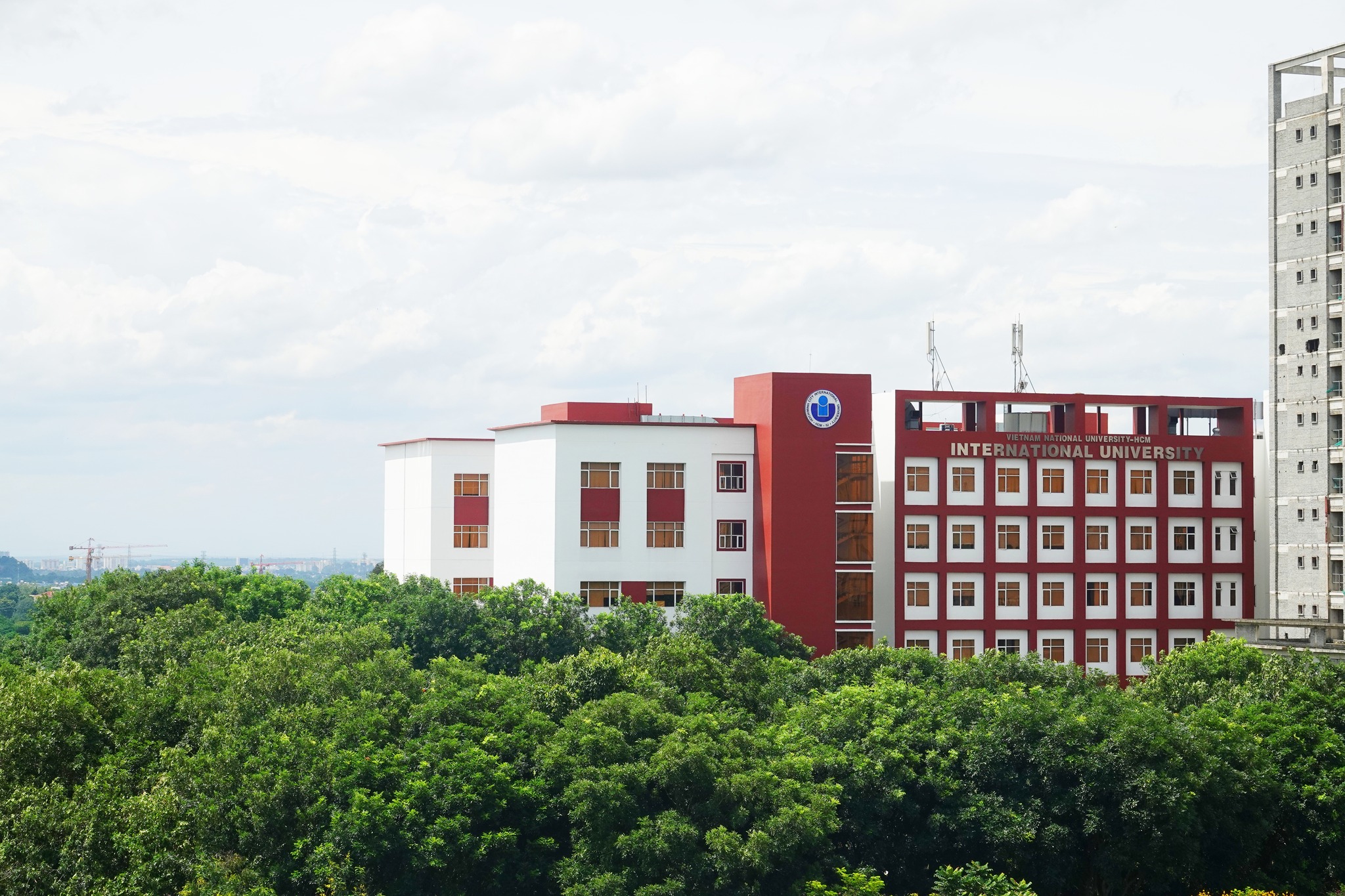
PROGRAMMES · POSTGRADUATE PROGRAMMES
PhD in Information Technology
Applicable from the 2026 intake · Tracks 1 / 2
General Information of the Programme
The programme develops independent research, the creation of new knowledge and IT research leadership. It includes advanced courses, a literature review, special studies, scientific publications and a dissertation.
Programme code: 9480201 · Mode: full-time
With a master’s degree: 3 years, 90 credits
Without a master’s degree: 4 years, 120 credits
Language: English · Awarding institution: International University, VNU-HCM
Award: Doctor of Philosophy in Information Technology
Curriculum
The core pathway comprises 90 credits. Entrants without a master’s degree complete at least 30 additional credits; supplementary study for master’s holders is considered individually.
| Component | Track 1 | Track 2 |
|---|---|---|
| Research Methodology | 3 | 3 |
| Doctoral electives | 0 | 6 |
| Literature Review | 5 | 5 |
| Two doctoral special studies | 12 | 6 |
| Dissertation | 70 | 70 |
| Core pathway total | 90 | 90 |
Track 1 includes two 6-credit special studies. Track 2 includes two 3-credit special studies and two 3-credit electives. Scientific publications are a separate requirement and are not added as course credits.
POs/PLOs
Objectives focus on advanced expertise, identifying and solving new problems, scientific publication and research supervision. The six outcomes retain the programme’s SLO1–SLO6 identifiers.
SLO1: Advanced, current and systematic IT knowledge.
SLO2: Master research methodology and develop specialist knowledge.
SLO3: Demonstrate critical thinking, creativity and research leadership.
SLO4: Work across disciplines and communicate academically in English.
SLO5: Make expert judgements and take responsibility for research.
SLO6: Manage research, pursue lifelong learning and create new solutions.
Program Specification
The programme document brings together general information, objectives, outcomes, the course–outcome matrix and curriculum structure. It is a curriculum framework, rather than a collection of detailed course syllabi.
View / download the complete curriculum
Doctoral: applicable from the 2026 intake; Decision 1662/QĐ-ĐHQT dated 31 December 2025, 11 pages.
Course List
The list groups courses by code to avoid duplicates across study directions. Short introductions are editorial summaries of each course topic; detailed content and requirements belong in the individual syllabi.
IT601 · Research Methodology
3 credits · Tracks 1/2
Develops approaches to defining problems, designing methods and communicating research results.
IT650 · Literature Review
5 credits · Tracks 1/2
Synthesises and analyses related work to identify a research problem and direction.
IT651 · Special Study 1A
6 credits · Track 1
Focuses on a specialist topic aligned with the study or research direction.
IT652 · Special Study 2A
6 credits · Track 1
Focuses on a specialist topic aligned with the study or research direction.
IT655 · Special Study 1B
3 credits · Track 2
Focuses on a specialist topic aligned with the study or research direction.
IT656 · Special Study 2B
3 credits · Track 2
Focuses on a specialist topic aligned with the study or research direction.
IT642 · Advanced Information System Management
3 credits · Elective · track 2
Examines the organisation and management of information systems in organisations.
IT622 · Advanced Data Warehousing and Data Mining
3 credits · Elective · track 2
Studies data warehouse organisation and the discovery of knowledge from data.
IT606 · Advanced Big Data Analytics
3 credits · Elective · track 2
Explores approaches to processing and analysing large datasets.
IT632 · Distributed Computing
3 credits · Elective · track 2
Studies the organisation and coordination of processing in distributed systems.
IT609 · Advanced Data Visualization
3 credits · Elective · track 2
Explores visual representations that support data analysis and communication.
IT648 · Advanced IT Project Management
3 credits · Elective · track 2
Studies planning, coordination and management of information technology projects.
IT649 · Advanced Natural Language Processing
3 credits · Elective · track 2
Studies computational methods for processing and using language data.
IT607 · Advanced Compiler
3 credits · Elective · track 2
Examines programme analysis and translation in compiler systems.
IT621 · Advanced Software Designs and Architectures
3 credits · Elective · track 2
Studies organisation, design and architectural choices for software systems.
IT616 · Advanced Computer Graphics
3 credits · Elective · track 2
Explores methods for representing and processing computer graphics.
IT608 · 3D Visualization for VR and AR
3 credits · Elective · track 2
Explores three-dimensional content in virtual and augmented reality environments.
IT644 · Network Security
3 credits · Elective · track 2
Studies the protection of data and computer network operations.
IT625 · Information Systems Security
3 credits · Elective · track 2
Examines information protection and security management in information systems.
IT631 · Advanced Network Management
3 credits · Elective · track 2
Studies the management, monitoring and operation of computer networks.
IT636 · Advanced Internet of Things
3 credits · Elective · track 2
Examines device connectivity, data exchange and applications in Internet of Things systems.
IT615 · Advanced Data Structures and Algorithms
3 credits · Elective · track 2
Studies advanced data structures and algorithms for computational problems.
IT602 · Advanced Databases
3 credits · Elective · track 2
Explores advanced topics in organising, managing and using databases.
IT617 · Advanced Cryptography
3 credits · Elective · track 2
Studies cryptographic principles for protecting information and data exchange.
IT604 · Advanced Artificial Intelligence
3 credits · Elective · track 2
Explores methods for systems that reason and solve problems.
IT645 · Advanced Algorithm Optimization
3 credits · Elective · track 2
Studies how to improve algorithm efficiency and select suitable computational approaches.
IT653 · Doctoral Dissertation
70 credits · Tracks 1/2
Develops and presents independent research and the doctoral candidate’s scientific contribution.
PE505 · Philosophy
Subject to entrant background
Introduces philosophical foundations and ways of thinking in study and research.
IT515 · Advanced Data Structures and Algorithms
4 credits · Supplementary course
Studies advanced data structures and algorithms for computational problems.
IT502 · Advanced Database
4 credits · Supplementary course
Explores advanced topics in organising, managing and using databases.
IT516 · Advanced Computer Graphics
4 credits · Supplementary course
Explores methods for representing and processing computer graphics.
IT517 · Cryptography
4 credits · Supplementary course
Studies cryptographic principles for protecting information and data exchange.
PE502 · Professional Ethics
2 credits · Supplementary course
Examines professional responsibility and ethical issues in information technology.
IT545 · Algorithm Optimization
4 credits · Supplementary course
Studies how to improve algorithm efficiency and select suitable computational approaches.
IT548 · Advanced IT Project Management
4 credits · Supplementary course
Studies planning, coordination and management of information technology projects.
IT504 · Artificial Intelligence
4 credits · Supplementary course
Explores methods for systems that reason and solve problems.
Philosophy requirements depend on the entrant’s background. The eight supplementary courses for entrants without a master’s degree are included and labelled separately.
Module Handbook, Course Description, Syllabus
The curriculum framework provides course names, codes, credits and the outcome mapping. The module handbook and individual syllabi are being updated; the summaries on this page do not replace them.
Teaching & Learning Approach
Research is central to the pathway: advanced study, literature review, special studies and a dissertation. The programme develops independent thinking, academic communication and research leadership.
Student Assessment
Graduation requirements follow the University’s doctoral training regulations. Research and publication outputs must meet the selected track’s requirements, detailed in section 3.2 of the programme document.
Accreditation
Accreditation information specific to the doctoral programme is being updated. Master’s or undergraduate certificates do not establish accreditation for the doctoral programme.
Improvement
The version applies from the 2026 intake under Decision 1662/QĐ-ĐHQT dated 31 December 2025. Comparisons between versions and evidence of improvement outcomes are being updated.
Statistics and Graduate Outcomes
Programme career directions include teaching, research, R&D, technology consulting and leadership of research teams or IT projects. These are intended directions; cohort-level graduation and actual employment outcomes are being updated.
Thesis Guideline
IT653 carries 70 credits in both tracks. The pathway includes a literature review, special studies and publications related to the dissertation. Publication requirements differ between tracks 1 and 2; consult section 3.2 rather than applying one criterion to all candidates. Formatting and defence procedures are being updated separately.